Veneers and crowns are among the most common dental treatments when it comes to cosmetic dentistry. Everyone wants to have a beautiful and healthy smile, so in this article we will introduce you to what veneers and crowns are, so that you can make a more informed choice about which of the two treatments is best for you.
The main difference between veneers and crowns is how much of the tooth they cover. Crowns usually cover the rest of the tooth on all sides. Veneers only cover the front part of the teeth, which is visible when a person smiles.
What are facets?

Veneers are thin shells of porcelain, ceramic, or composite material that are custom-made for each patient. Their main purpose is to enhance a smile by balancing the size, shape, and color of your teeth. Veneers are bonded to the front of your teeth and can help treat a variety of dental problems, including:
Broken or damaged teeth;
Distances between teeth;
Excessive tooth wear;
Discoloration;
Misaligned teeth.
Whether made of porcelain, ceramic, or composite materials, the main purpose of veneers is to match the natural shade of teeth. Their main application is in cosmetic dentistry, which is why they are a great choice for a whiter and more aligned smile, but they are not applicable for severely damaged or missing teeth.
Veneers are a minimally invasive dental treatment and in some cases can be placed without changing the shape of the tooth at all.
What are crowns?

Crowns are mainly used for severely damaged teeth, whether because the tooth is broken, worn or after endodontic treatment. They are also used on implants when it comes to a missing tooth. Their function is not only aesthetic but also protective, which is why crowns are a stronger and more durable dental treatment. Like veneers, dental crowns are made individually for each patient to resemble a natural tooth and replace it in all its functions.
Here are the main differences between veneers and crowns
Tooth coating
Veneers cover only the outer part of the teeth to improve the appearance of the smile.
Crowns cover the tooth on all sides and, in addition to good appearance, must improve chewing function and support occlusal loads.
Filing teeth
Filing involves reducing the natural volume of the tooth so that the veneer or crown can fit perfectly.
For crowns, the tooth must be filed down by about 2 millimeters. While for veneers, modern technologies have led to the production of ultra-thin veneers, which sometimes do not even require filing. However, in most cases, a minimum filing of between 0.3 and 0.7 millimeters is required.
Purpose
Veneers are used only for cosmetic dentistry. Their main purpose is to change the shape, size, and color of teeth so that the end result is an aesthetically more beautiful smile.
Crowns, on the other hand, are not only aesthetic but also functional. They are used when a tooth is severely damaged, broken, or missing. In the latter option, crowns are placed on dental implants.
Which teeth are they placed on?
Veneers are usually bonded to the visible teeth – the upper central and static incisors.
Crowns also have a functional purpose, so they can be placed on any tooth. They are usually placed on premolars and molars, as these are the teeth where larger and deeper cavities develop.
Material they are made of
Veneers can be made of porcelain, ceramic, or composite. Porcelain and ceramic veneers have a better aesthetic appearance and are more durable. They also do not discolor over time. With proper care and maintenance, these veneers can last up to 30 years. Composite veneers, on the other hand, require more frequent periodic maintenance. They are not as durable and strong, but their main advantage is that they are cheaper.
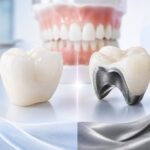
Crowns can be porcelain, metal-ceramic, and zirconium. In the past, gold crowns were even used. They can be placed on both visible teeth and molars. Porcelain or zirconium crowns are usually used for visible teeth, as they have a better aesthetic appearance. Metal-ceramic crowns are recommended for molars, because of their better durability and strength.
When can porcelain veneers be used:
In case of unwanted tooth discoloration;
After whitening, when the color of the teeth has not changed;
When the shape and position of the teeth does not have a good aesthetic appearance.
When can porcelain crowns be used:
When teeth are seriously damaged due to severe caries;
In the presence of a broken or missing tooth;
For cracked teeth with a high risk of fracture.
Advantages of porcelain veneers:

Smile – a natural-looking smile with high durability and longevity.
Natural appearance – Extremely high aesthetics. In practice, the treated teeth are almost indistinguishable from natural teeth.
Hardness – Similar to that of natural tooth enamel.
Durability – Composite veneers have a lifespan of 8 to 10 years. Porcelain veneers have a much longer lifespan – 15 – 20 years.
Advantages of porcelain crowns

The ceramic material they are made of is biocompatible and does not cause any allergic reactions.
The smile has a good aesthetic appearance, thanks to the appearance and transparency of the ceramic material.
Porcelain crowns are a cheaper option than zirconia crowns, but zirconia crowns still have an even better aesthetic appearance.
Main advantages of veneers and crowns

Better appearance – Dental veneers or crowns can significantly improve the appearance of teeth. They correct dental problems such as worn tooth enamel, improper alignment or spacing of teeth, discoloration and stains on the teeth.
Reduces jaw pain – provide a protective barrier that can prevent further damage caused by wear and tear on teeth.
Improve self-esteem – a good-looking smile also improves confidence and self-esteem.
Protects against cavities – crowns and veneers provide an additional layer of protection for teeth by isolating vulnerable areas, inhibiting the development of bacteria, and thereby reducing the likelihood of developing caries.
Durability and longevity – Crowns and veneers can last for many years if they are properly cared for. Maintaining good oral hygiene is a key factor in this process. Teeth should be brushed at least twice a day and flossed once a day.
What are the steps for veneers:
The patient undergoes a thorough initial examination;
A minimal amount of enamel is usually removed to prepare the teeth. A local anesthetic may be used during this procedure;
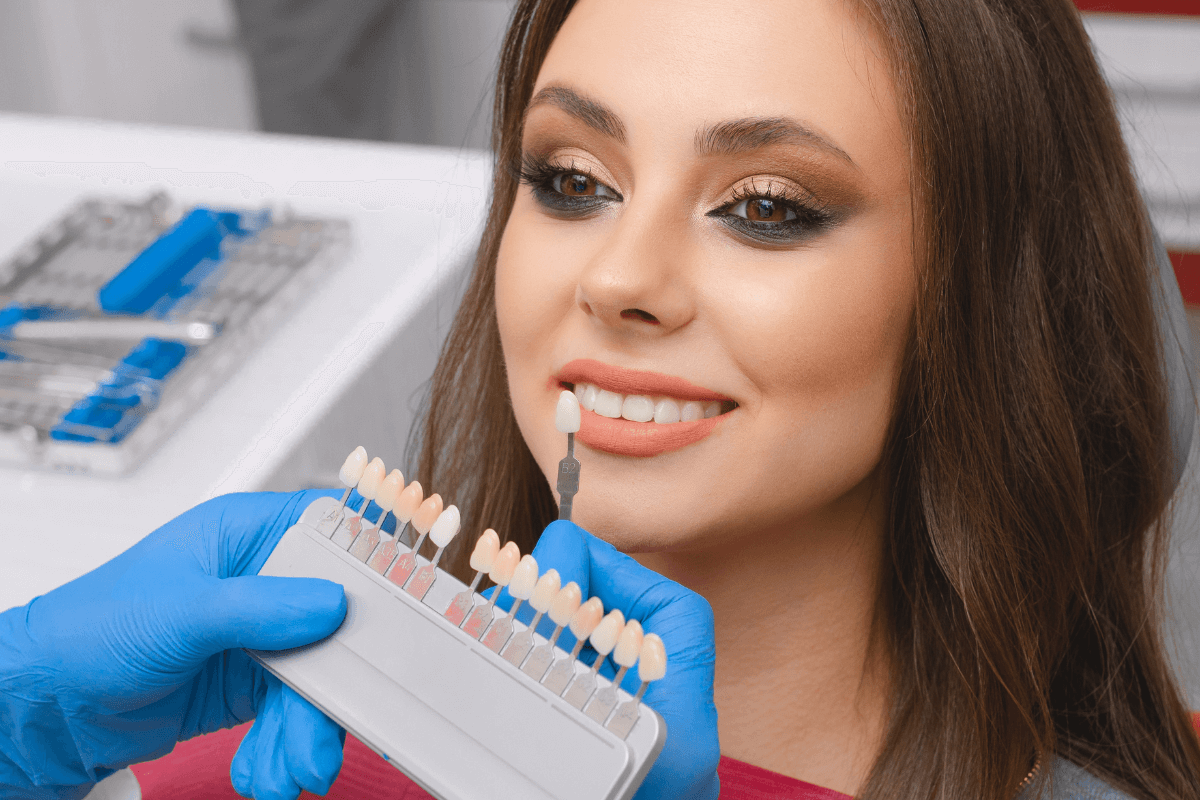
An impression of the teeth is made and the shade and color of the veneers are selected;
Production of veneers by a specialist dental technician;
Placing the finished veneers on the patient's natural teeth;
Periodic monitoring of results – it is recommended to visit a dentist at least twice a year.
What are the steps for crowns:
The crown is fixed with a special glue.
Filing the tooth to fit the crown properly. A local anesthetic may be used at this stage;
Taking an impression and sending it to a dental technician to make the crown;
Placing a temporary acrylic crown until the permanent one is ready;
The finished crown is placed and the necessary adjustments are made;
The patient undergoes a thorough initial examination;
At Specialized dental clinic Bushkalova we perform dental treatment with facets and crownsWe offer all varieties – zirconia, porcelain, ceramic and composite veneers, as well as zirconia, porcelain and metal-ceramic crowns.
The clinic has its own dental laboratory, so everything is done in one place - from the initial examination, to the taking of impressions, to the making of veneers and crowns and their bonding to the teeth.
Book your appointment now and enjoy a beautiful, aesthetic and healthy smile!